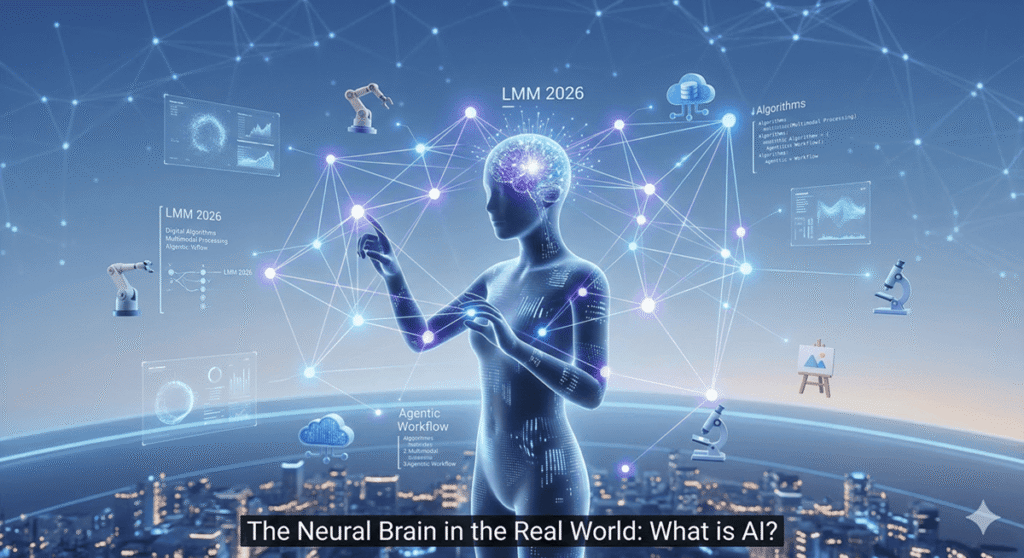
Executive Summary: What is AI in 2026?
When asking what is ai in 2026, the answer extends far beyond basic text chatbots and static predictive models. Modern Artificial Intelligence is defined as the integration of Large Multimodal Models (LMMs), Autonomous Agentic Workflows, and Low-Latency Neural Silicon capable of perceiving, reasoning, planning, and executing multi-step physical and digital tasks asynchronously. Rather than functioning as a passive search engine or simple typing assistant, contemporary AI operates as an active cognitive infrastructure across enterprise automation, software engineering, real-time voice synthesis, and scientific discovery.
Artificial intelligence has transitioned from a theoretical computer science discipline into the foundational utility of the global economy. In earlier technological cycles, asking what is ai yielded references to rule-based expert systems, chess-playing algorithms, or basic statistical spam filters. Today, the paradigm has shifted entirely. We have entered the era of physical, agentic, and multimodal machine intelligence.
This comprehensive technical handbook unpacks the complete landscape of artificial intelligence in 2026. Designed for software professionals, business leaders, researchers, and digital builders, this guide explores foundational neural architectures, the mechanical mechanics of Large Multimodal Models, the emergence of autonomous software swarms, hardware silicon advancements, environmental energy constraints, and actionable frameworks for adopting modern AI tools.
Table of Contents
- 1. Core Definition: What is AI in the Modern Era?
- 2. The Evolutionary Timeline: From Symbolic Logic to Multimodal LMMs
- 3. Mechanical Foundations: ML, Deep Learning & Transformers
- 4. Generative AI vs. Predictive AI: The Paradigm Split
- 5. The Rise of Agentic AI: From Passive Chatbots to Autonomous Swarms
- 6. Silicon Infrastructure: GPUs, LPUs, and Neural Compute
- 7. Environmental Sustainability: Energy, Water, and Green AI
- 8. Societal & Economic Impact: Labor Transformation & Governance
- 9. AI Architectural Paradigm Comparison Matrix
- 10. Common Implementation Traps: Who Should NOT Deploy AI?
- 11. Future Outlook: Towards Artificial General Intelligence (AGI)
- 12. Frequently Asked Questions
1. Core Definition: What is AI in the Modern Era?
To accurately answer what is ai today, one must dismantle outdated textbook descriptions. At its core, Artificial Intelligence refers to computational systems engineered to simulate human cognitive functions—including spatial perception, contextual reasoning, linguistic translation, multi-step planning, and autonomous decision-making.
However, 2026 marks a pivotal evolutionary milestone. Modern AI systems are no longer restricted to processing isolated data formats. Instead, they leverage native multimodality:
- Multimodal Ingestion: A single neural network simultaneously processes high-definition video feeds, spoken audio streams, complex raw codebases, structured financial tables, and spatial sensor telemetry without requiring separate translation layers.
- Contextual Reasoning: Advanced reasoning architectures utilize chain-of-thought verification, permitting systems to double-check their internal logic before delivering output.
- Autonomous Execution: Systems possess digital tool-use permissions, allowing them to independently query databases, execute terminal scripts, manage cloud infrastructure, and invoke third-party APIs to achieve user-defined goals.
2. The Evolutionary Timeline: From Symbolic Logic to Multimodal LMMs
Understanding what is ai requires tracing how computational intelligence evolved across distinct technological epochs over the past seven decades:
1. The Symbolic & Rule-Based Era (1950s – 1990s)
Early AI systems relied entirely on hardcoded human logic. Programmers manually wrote exhaustive conditional statements (if-then-else rules). While successful in controlled environments like chess computers or diagnostic decision trees, these systems lacked adaptability and collapsed when encountering unstructured real-world ambiguity.
2. The Statistical Machine Learning Era (2000s – 2010s)
The advent of digital internet storage enabled a fundamental shift from explicit instruction to data-driven learning. Algorithms such as Random Forests, Support Vector Machines (SVMs), and Naive Bayes classifiers began scanning vast datasets to detect hidden statistical patterns independently.
3. The Deep Learning & Transformer Revolution (2017 – 2023)
The introduction of the Transformer neural network architecture in 2017 revolutionized natural language processing. By employing self-attention mechanisms, Transformers allowed models to process massive text corpora in parallel, giving birth to Large Language Models (LLMs) capable of generating human-grade writing, translating languages, and writing software.
4. The Agentic & Multimodal Era (2024 – 2026)
Today, static text windows have been replaced by native multimodal reasoning engines and autonomous software swarms that interact continuously with physical and virtual environments.
3. Mechanical Foundations: ML, Deep Learning & Transformers
To comprehend how modern AI functions under the hood, it is essential to clarify the hierarchical relationship between key computer science disciplines:
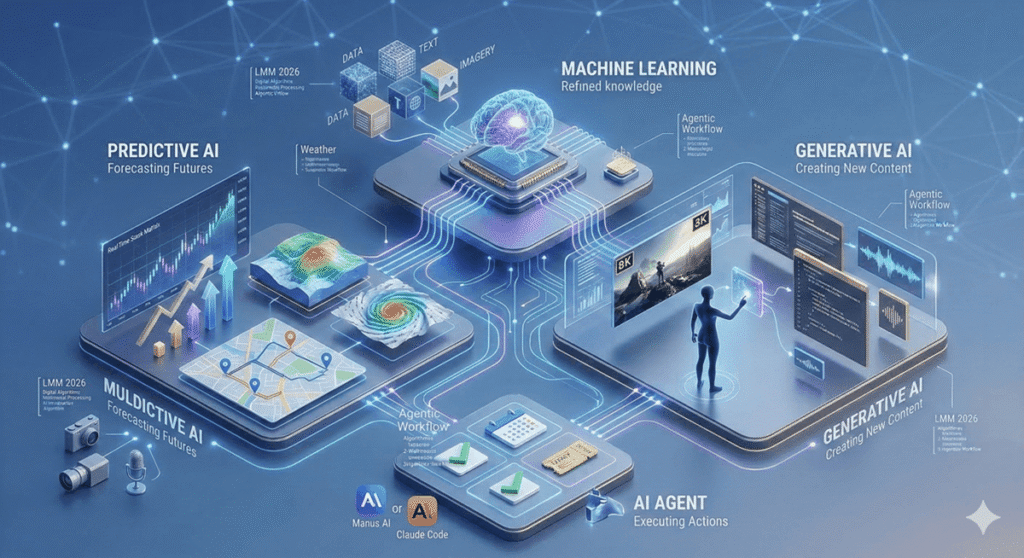
Artificial Intelligence > Machine Learning > Deep Learning > Transformer Architectures
Machine Learning (ML)
Machine Learning is a subset of AI where mathematical models train on historical data to predict outcomes or categorize inputs without being explicitly programmed for every scenario. Training paradigms include:
- Supervised Learning: Models train on labeled datasets (e.g., thousands of medical scans marked as “healthy” or “pathological”) to learn predictive mappings.
- Unsupervised Learning: Models analyze unlabeled data to discover hidden clusters, customer segmentation groups, or fraud anomalies naturally.
- Reinforcement Learning (RL): Agents learn optimal behavioral policies by trial-and-error, receiving digital rewards for successful choices and penalties for errors.
Deep Learning & Neural Networks
Deep Learning scales Machine Learning by stacking artificial neural networks into deep computational layers modeled loosely on human synaptic processing. Each mathematical layer extracts increasingly abstract features from raw input data—progressing from simple pixel edges to full object recognition in computer vision pipelines.
Transformer Architectures & Attention Mechanisms
The core engine driving modern generative models is the Transformer. Unlike older recurrent neural networks (RNNs) that processed data sequentially word-by-word, Transformers analyze entire documents simultaneously using Self-Attention. This mechanism calculates mathematical weight matrices between every word in a sequence, allowing the model to grasp subtle contextual nuances, long-range dependencies, and structural semantics instantly.
4. Generative AI vs. Predictive AI: The Paradigm Split
When evaluating what is ai across commercial software applications, systems generally fall into two primary functional categories:
Predictive AI: Analytical Forecasting
Predictive AI analyzes historical data distributions to forecast future probability metrics. It answers questions such as: “What is the probability this credit card transaction is fraudulent?” or “Which industrial server component is likely to experience hardware failure in the next 30 days?”
- Core Applications: Algorithmic stock trading, logistics demand planning, medical risk scoring, and cybersecurity anomaly detection.
- Primary Value: Risk mitigation and operational precision.
Generative AI: Creative Synthetic Production
Generative AI utilizes deep probabilistic models to produce novel, high-fidelity synthetic media based on contextual prompt inputs. Instead of merely categorizing existing items, Generative AI outputs new content across text, code, visual imagery, 3D assets, audio synthesis, and video production.
To see how generative models transform daily workflows, explore our master guide to the best ai tools for productivity. For creators building professional media pipelines, examine our detailed evaluation of synthetic audio platforms in Murf AI vs ElevenLabs, or test live vocal processing in our guide to the best real time ai voice changer tools and best discord voice changer utilities.
5. The Rise of Agentic AI: From Passive Chatbots to Autonomous Swarms
The single most consequential evolution in answering what is ai in 2026 is the transition from static conversational bots to Agentic AI.
A conventional chatbot requires continuous human prompting: a user asks a question, receives a text reply, and must manually perform the next step. In contrast, an AI Agent operates with task autonomy. When given a complex top-level objective—such as “Conduct market analysis on competitor pricing and update our cloud database”—an agentic system:
- Breaks the master goal down into discrete sub-tasks.
- Queries external search indexes to gather fresh intelligence.
- Invokes web scraping tools and validates data formatting.
- Detects software exceptions, fixes its own code errors, and re-runs operations.
- Writes updated records into production cloud infrastructure.
To master building and deploying these autonomous agent networks, review our architectural comparison of LangGraph vs CrewAI, explore production software libraries in our best agentic ai tools catalog, and audit deployment security guidelines in our deep dive on best ai agent guardrails.
6. Silicon Infrastructure: GPUs, LPUs, and Neural Compute
Artificial intelligence is not an abstract cloud concept; it is anchored in physical silicon infrastructure. Running billions of matrix multiplication equations per second demands specialized hardware architectures designed specifically for parallel mathematical processing.
Graphics Processing Units (GPUs)
Originally designed for 3D video game rendering, GPUs feature thousands of small cores optimized for simultaneous mathematical calculations. They remain the dominant silicon architecture for training multi-trillion parameter foundation models.
Language Processing Units (LPUs) & Custom ASICs
In 2026, inference latency (the speed at which a model generates answers after receiving a prompt) has been transformed by specialized chips like LPUs and custom Neural Processing Units (NPUs). These processors utilize ultra-fast SRAM memory architectures to stream token outputs at hundreds of words per second, making real-time voice translation and instant agent responses possible.
To learn how to optimize compute performance across cloud architectures, read our technical review of the best ai inference engines and discover management solutions in our overview of best ai api management tools.

7. Environmental Sustainability: Energy, Water, and Green AI
A comprehensive explanation of what is ai would be fundamentally incomplete without addressing its physical footprint. As neural networks expand in scale, their compute requirements demand immense electrical power and cooling infrastructure.
The Environmental Cost of Compute
- Electricity Consumption: Hyperscale AI data centers consume gigawatts of electricity daily. Training a single frontier multi-modal model can require as much power as thousands of modern homes consume over an entire year.
- Water Usage: High-density GPU server racks generate extreme heat, requiring millions of gallons of fresh water for evaporative cooling towers to prevent hardware meltdowns.
- Carbon Emissions: If powered by fossil-fuel energy grids, compute infrastructure contributes significantly to global carbon output.
The “Green AI” Movement
To ensure long-term viability, tech giants and open-source communities are aggressively deploying Green AI protocols:
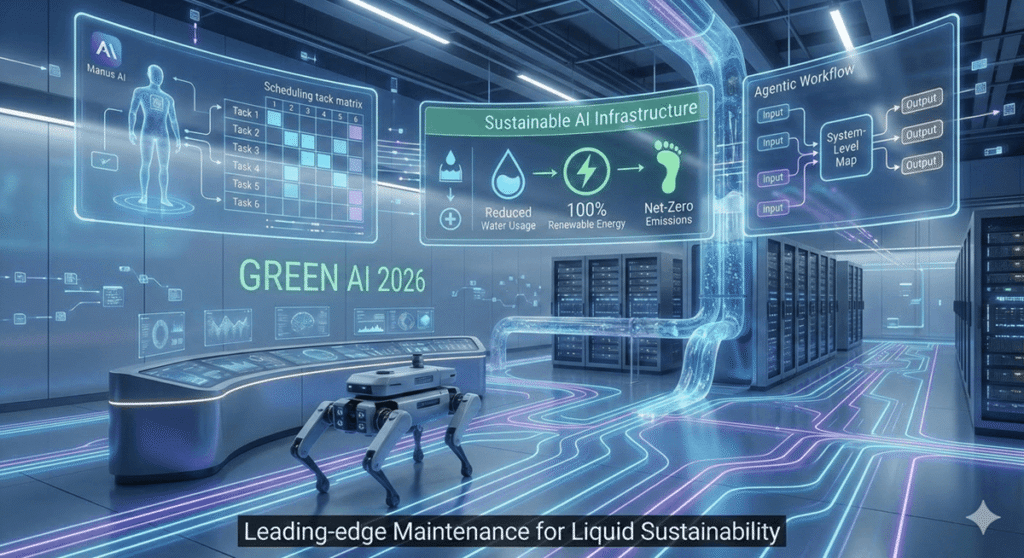
- Liquid Cooling & Closed-Loop Systems: Modern data centers are replacing open water towers with closed-loop dielectric liquid submersion tanks, reducing water consumption by over 90%.
- Model Quantization & Distillation: Techniques like 4-bit quantization allow smaller, highly optimized models to deliver 95% of a frontier model’s performance while using a fraction of the electricity.
- Geographic Compute Routing: Modern AI workloads are dynamically routed across global fiber networks to data centers operating on active solar, wind, or nuclear power grids at any given hour.
8. Societal & Economic Impact: Labor Transformation & Governance
As AI transitions from software utility to cognitive layer, its societal implications are reshaping global business models and employment structures.
Labor Augmentation vs. Displacement
Historically, industrial automation replaced repetitive manual labor. Modern AI primarily augments cognitive, creative, and technical knowledge work. Software engineers now write code alongside AI pair programmers; medical researchers use neural networks to predict protein folding structures in days rather than decades; and customer operations teams deploy autonomous agents to handle tier-1 support queries.
AI Governance & Ethical Frameworks
Governments worldwide have instituted strict regulatory frameworks (such as the EU AI Act) to manage systemic risks. Key compliance pillars include:
- Algorithmic Transparency: Enforcing clear audit trails for high-risk automated decisions in mortgage approvals, hiring, and law enforcement.
- Watermarking & Provenance: Mandating cryptographic metadata tags on synthetic video, audio, and text to combat deepfakes and misinformation.
- Data Privacy & Zero-Data-Retention: Ensuring corporate and user confidential data cannot be harvested to train public foundation models without consent.
9. AI Architectural Paradigm Comparison Matrix
Review this side-by-side technical evaluation to compare core specifications across modern artificial intelligence paradigms:
| AI Paradigm | Primary Mechanism | Core Output | Autonomy Level | Ideal Commercial Use Case |
|---|---|---|---|---|
| Predictive AI | Statistical pattern classification | Probability scores & numerical forecasts | Low (Requires manual system triggers) | Fraud detection, inventory planning, medical risk scoring |
| Generative AI | Probabilistic Transformer synthesis | Text, code, audio, 3D, and 8K video | Moderate (Copilot / Prompt-driven) | Content creation, software drafting, media editing |
| Agentic AI | Cyclical state machines & tool usage | Multi-step task execution & workflow state changes | High (Asynchronous goal solving) | Autonomous DevOps, research synthesis, customer ops |
| Embedded / Edge AI | Quantized local neural execution | Low-latency real-time sensor processing | Variable (Hardware bounded) | Autonomous vehicles, robotics, mobile voice engines |
10. Common Implementation Traps: Who Should NOT Deploy AI?
While artificial intelligence offers transformational efficiencies, deploying these technologies blindly introduces significant operational risks. Organizations should avoid AI integration under the following conditions:
- Unstructured Business Operations: AI tools amplify underlying workflows. If your organization lacks clear Standard Operating Procedures (SOPs) or clean database architectures, deploying automated agents will only accelerate administrative disorganization.
- Zero-Tolerance Deterministic Environments: Generative models are inherently probabilistic. Applications that require 100% absolute mathematical certainty without human oversight—such as safety-critical flight control or nuclear hardware controllers—must rely on deterministic software rather than probabilistic LLMs.
- Lack of Human-in-the-Loop (HITL) Guardrails: Deploying customer-facing autonomous agents capable of making legally binding financial commitments without human review checkpoints invites severe financial and reputational liabilities.
11. Future Outlook: Towards Artificial General Intelligence (AGI)
As we look beyond 2026, the ultimate milestone in AI development remains Artificial General Intelligence (AGI)—defined as synthetic systems capable of matching or exceeding human cognitive performance across all economically valuable domain tasks.
The transition toward AGI relies on solving three foundational challenges:
- Continuous Test-Time Compute: Enabling models to reflect on complex problems for minutes or hours before answering, unlocking breakthroughs in quantum physics and molecular biology.
- Embodied Physical AI: Integrating advanced multimodal neural brains directly into humanoid robotics capable of navigating real-world warehouses, construction sites, and surgical operating rooms.
- Energy-Efficient Neuromorphic Computing: Engineering hardware chips that emulate the biological brain’s ability to perform massive parallel reasoning using watts rather than megawatts.
12. Frequently Asked Questions
What is AI in simple terms?
In simple terms, Artificial Intelligence (AI) refers to computer systems designed to perform tasks that typically require human intelligence. This includes understanding natural spoken language, recognizing images, making complex decisions, learning from past experience, and solving problems autonomously.
What is the main difference between AI, Machine Learning, and Deep Learning?
Artificial Intelligence is the broad overarching field of creating smart machines. Machine Learning (ML) is a specific branch of AI where algorithms learn patterns from data instead of being explicitly programmed. Deep Learning is an advanced subset of ML that uses multi-layered artificial neural networks to process unstructured data like text, audio, and video.
Will AI replace human software developers and knowledge workers?
In 2026, AI is primarily replacing repetitive manual processes rather than human ingenuity. While autonomous agents handle routine coding, data entry, and research, high-level system architecture, strategic reasoning, creative direction, and empathetic leadership remain uniquely human domains.
How can beginners start learning and using AI tools today?
Beginners should start by mastering general multimodal assistants like ChatGPT or Claude for daily tasks. From there, explore specialized workflow automation tools, learn basic prompt engineering techniques, and follow technical analysis hubs to stay informed on emerging models.
To explore more software categories or upgrade your digital workflow, visit our master AI Tools repository or stay updated with weekly industry releases in our AI News hub!
Pingback: Best Free AI Tools 2026
Pingback: Best AI Detectors to Verify Human Content in 2026
Pingback: Claude Code Tutorial 2026: The Ultimate Full-Stack Guide