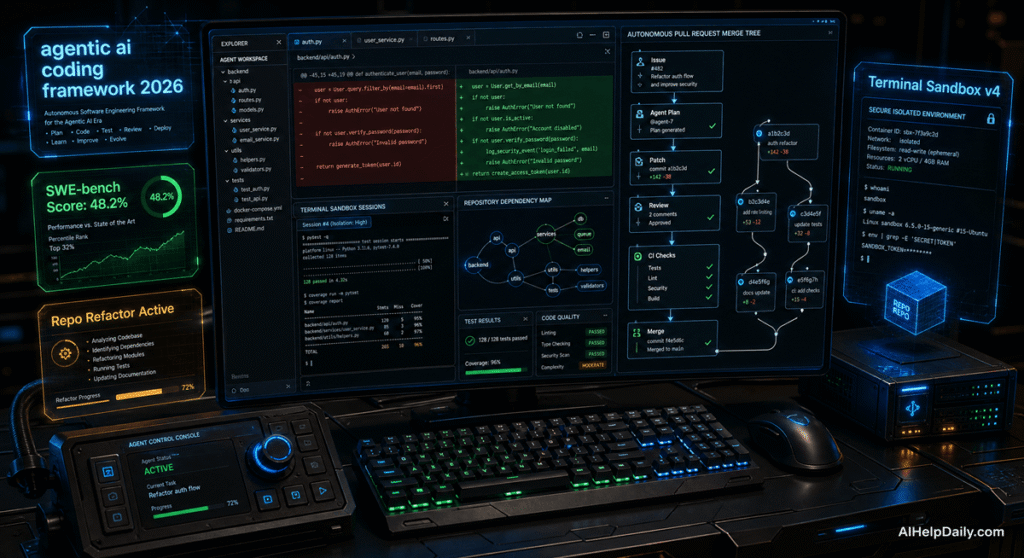
Agentic ai coding framework architectures are fundamentally redefining how software engineering teams, open-source contributors, and technology startups build full-stack applications in 2026. In this detailed benchmark evaluation, we review top autonomous coding environments to help you automate repository-wide refactoring, resolve GitHub issues, and deploy self-healing software loops.
Table of Contents
- The Autonomous Software Engineering Shift: Introduction
- Key Parameters: Evaluating Autonomous Developer Frameworks
- The Best Agentic AI Coding Frameworks in 2026 Reviewed
- Functional Deployment Across Modern Git and CI/CD Pipelines
- The Heavy Computation: Processing Load and Infrastructure Demands
- Conclusion: The Final Verdict
The Autonomous Software Engineering Shift: Introduction
The daily workflow of writing boilerplate code, debugging runtime stack traces, and reviewing pull requests has officially evolved beyond single-line autocomplete extensions and passive chat co-pilots. Engineering leads, full-stack developers, and DevOps teams no longer spend entire sprints manually fixing dependency breakages or writing routine integration test suites from scratch.
In this dedicated architectural evaluation, we benchmark real-world SWE-bench test repositories to rank the best agentic ai coding framework options operating in the 2026 software development landscape. We evaluate their multi-file code editing precision, local terminal command execution safety, test-driven validation cycles, and Git version control synchronization.
Key Parameters: Evaluating Autonomous Developer Frameworks
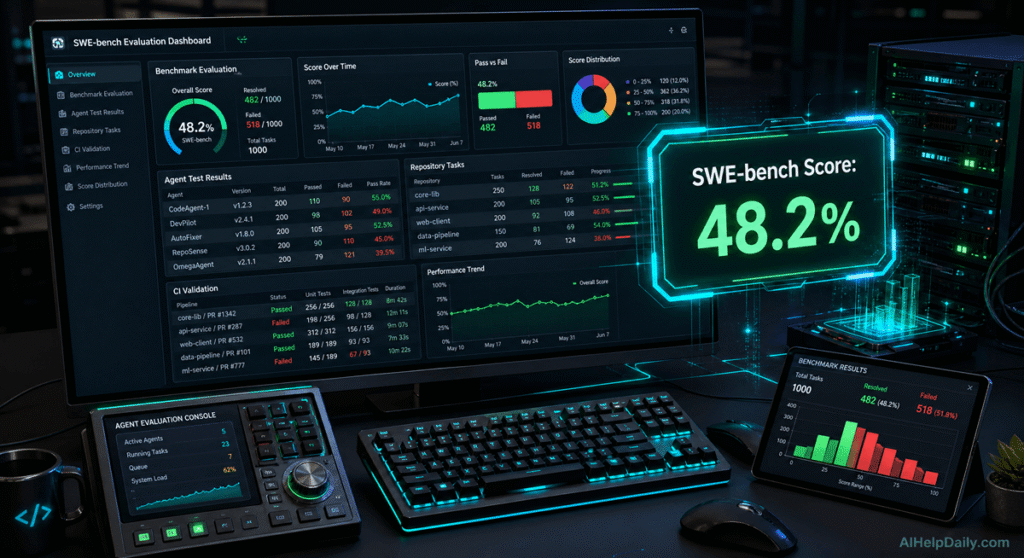
To properly evaluate a modern agentic ai coding framework, engineering managers and systems architects must look past single-function code generation and analyze holistic repository understanding. A production-ready autonomous coding system must parse complex Abstract Syntax Trees (AST) across massive codebases without breaking architectural boundaries.
The underlying execution engine must operate safely inside isolated sandbox environments, execute local test commands to verify code changes, and autonomously iterate when compiler errors arise. Furthermore, an enterprise-grade agent framework must support seamless GitHub and GitLab webhook integrations, automated branch creation, and cryptographically signed commit workflows.
The Best Agentic AI Coding Frameworks in 2026 Reviewed
1. SWE-agent (Princeton NLP)
SWE-agent stands as the academic and open-source pioneer for turning foundation models into autonomous software engineers. Powered by an innovative Agent-Computer Interface (ACI) specifically tuned for code repositories, SWE-agent enables models to browse file hierarchies, edit multi-line code blocks, and run Pytest suites autonomously to resolve real-world GitHub issues.
2. OpenHands (Formerly OpenDevin)
OpenHands provides a comprehensive, open-source platform for autonomous software development and cloud runtime execution. Equipped with secure Docker sandboxes, interactive browser tools, and a flexible agent architecture, OpenHands allows engineering teams to assign complex development tasks—from scaffolding new microservices to refactoring legacy APIs—with complete execution transparency.
3. MetaGPT
MetaGPT excels in multi-agent software organization, assigning distinct simulated roles (Product Manager, Architect, Project Manager, Engineer, QA Specialist) to collaborate on entire software projects. By transforming high-level natural language requirements into comprehensive design diagrams, API specifications, and modular code repositories, MetaGPT streamlines early-stage software prototyping.
4. Aider
Aider remains the premier terminal-based pair programming assistant for professional developers who want frictionless CLI agent workflows. Operating directly within local Git repositories, Aider automatically edits code across multiple project files, writes detailed Git commit messages, and formats code diffs with exceptional accuracy and minimal token overhead.
5. Cline (Autonomous VS Code Extension)
Cline bridges the gap between deep terminal execution and visual IDE workflows by embedding autonomous agent execution directly into Visual Studio Code. With granular permission controls for file modifications and terminal commands, Cline enables developers to inspect, approve, and guide autonomous coding steps in real time without leaving their primary editor.
Functional Deployment Across Modern Git and CI/CD Pipelines
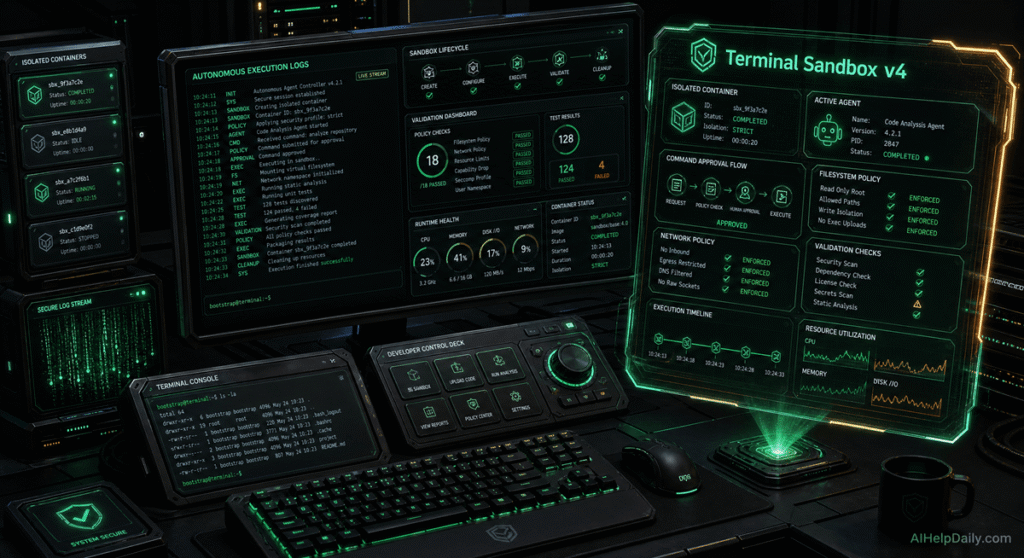
To help you isolate the agentic ai coding framework that best matches your team’s development environment, security controls, and repository scale, review this capabilities matrix:
The Heavy Computation: Processing Load and Infrastructure Demands
Executing multi-file code refactoring, managing dynamic abstract syntax trees, and running continuous integration test loops using an agentic ai coding framework places significant processing demands on cloud and local hardware. Serving multi-agent reasoning chains requires resilient hosting infrastructure and high-throughput inference backends.
This developer compute demand connects directly back to our comprehensive review of the best agentic ai tools, our best agentic ai frameworks breakdown, our best vector databases for ai agents guide, our best ai agent deployment platforms guide, and our recent best ai agent testing tools breakdown. Exploring how modern engineering teams balance continuous autonomous test execution sustainably remains an essential priority for global technology leaders.
Conclusion: The Final Verdict
Selecting the best agentic ai coding framework depends on whether your engineering organization prioritizes terminal-level pair programming or automated end-to-end repository maintenance. For professional software developers seeking rapid, precision Git commits directly in the terminal, Aider offers the most refined daily workflow. However, for engineering teams seeking autonomous full-repository issue resolution inside isolated sandboxes, OpenHands and SWE-agent provide the leading enterprise frameworks.
To explore more technical developer frameworks or discover platforms that scale your digital operational stack, visit our master AI Tools index or keep tabs on our continuous AI News weekly hub for ongoing industry breakdowns!