
AI 3d generators are fundamentally revolutionizing game development pipelines, 3D printing workflows, and spatial computing asset creation in 2026. In this detailed benchmark evaluation, we review top generative spatial platforms to help you convert text prompts and 2D images into game-ready textured meshes, clean quad topologies, and production PBR models without manual sculpting.
Table of Contents
- The Spatial Asset Shift: Introduction
- Key Parameters: Evaluating Generative 3D Mesh Engines
- The Best AI 3D Generators in 2026 Reviewed
- Functional Deployment Across Game & 3D Production Pipelines
- The Heavy Mesh: Processing Load and Infrastructure Demands
- Conclusion: The Final Verdict
The Spatial Asset Shift: Introduction
The production workflow for creating 3D game props, digital twin environments, spatial AR/VR assets, and 3D printing models has officially evolved past manual polygonal modeling loops and time-consuming texture painting. Game studios, indie developers, and industrial designers no longer spend weeks sculpting base meshes in traditional software packages from scratch.
In this dedicated industry evaluation, we benchmark leading generative spatial engines to rank the best ai 3d generators operating in the 2026 digital software landscape. We evaluate their text-to-3D generation accuracy, image-to-3D mesh reconstruction, PBR texture map quality, and quad topology export options.

Key Parameters: Evaluating Generative 3D Mesh Engines
To properly evaluate modern ai 3d generators, game technical directors and 3D artists must look past simple preview viewports and analyze true topology structure. A production-ready 3D generation platform must deliver clean polygon distribution without non-manifold geometry or surface distortion.
The underlying neural spatial engine must automatically generate watertight 3D meshes, export standard 3D formats (GLB, OBJ, FBX, STL), and output complete physically-based rendering (PBR) texture maps—including albedo, roughness, and normal maps. Furthermore, a top-tier spatial tool must feature auto-rigging capabilities for character models and fast UV unwrapping pipelines.
The Best AI 3D Generators in 2026 Reviewed
1. Meshy (Meshy 6)
Meshy 6 stands as the premier hosted all-in-one AI 3D generator for game developers and 3D printing creators. Operating with impressive topology tools, Meshy converts both text prompts and 2D images into clean GLB, OBJ, and STL files with production PBR texture maps, making it an essential bridge for game engines and additive manufacturing.
2. Tripo AI
Tripo AI excels in high-speed asset generation, auto-rigging character skeletons, and clean quad remeshing. Designed for fast game prototyping and digital asset pipelines, Tripo generates clean 3D assets in seconds, enabling developers to prototype interactive 3D worlds and animated characters seamlessly.
3. Rodin (Hyper3D)
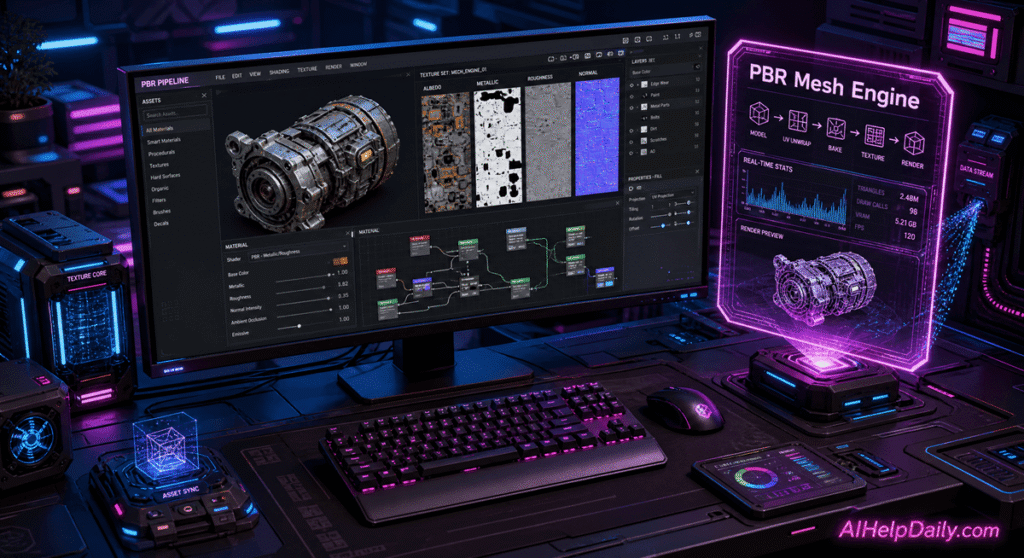
Hyper3D’s Rodin targets professional 3D sculptors and high-fidelity asset creators requiring extreme geometric detail. Delivering multi-million polygon mesh outputs with high-resolution PBR textures, Rodin processes complex multi-image inputs to reconstruct photorealistic 3D models with sculpt-level surface detail.
4. Spline 3D
Spline combines generative AI text-to-3D features with an intuitive, browser-based 3D design and web interaction workspace. Ideal for UI/UX designers, web developers, and marketing agencies, Spline enables creators to generate 3D assets and embed interactive, physics-driven 3D web experiences directly into live websites.
5. TRELLIS (Microsoft Research)
TRELLIS 2 represents the frontier of open-source image-to-3D generation, utilizing Gaussian Splatting and structured latent representations. Developed by Microsoft Research, TRELLIS produces photorealistic 3D visual outputs with natural lighting response, providing developers with a powerful open-weights foundation model for spatial research.
Functional Deployment Across Game & 3D Production Pipelines

To help you isolate the ai 3d generators that best match your team’s visual requirements, export formats, and technical stack, review this capabilities matrix:
The Heavy Mesh: Processing Load and Infrastructure Demands
Synthesizing complex multi-view 3D latent spaces and generating high-resolution spatial mesh geometry using modern ai 3d generators demands massive GPU cluster compute resources. Processing continuous 3D rendering queries shifts significant energy loads onto cloud hosting infrastructure.
This heavy digital compute demand connects directly back to the software infrastructure evaluations we conducted in our master best agentic ai tools guide, our best agentic ai frameworks breakdown, our best vector databases for ai agents guide, our best ai workflow automation tools review, and our recent best ai presentation tools guide. Exploring how global server networks balance these heavy spatial rendering workloads sustainably remains a top priority for modern technology providers.
Conclusion: The Final Verdict
Selecting among top ai 3d generators depends on whether your primary asset pipeline requires 3D printable meshes, game-ready rigged characters, or interactive web assets. For game developers and 3D printing creators seeking clean topology out of the box, Meshy 6 and Tripo AI offer the ultimate hosted spatial platforms. However, for web designers wanting to embed interactive 3D elements into live websites, Spline provides the premier browser-based workspace.
To explore more technical developer frameworks or discover platforms that scale your digital operational stack, visit our master AI Tools index or keep tabs on our continuous AI News weekly hub for ongoing industry breakdowns!